What are AI product descriptions and why do they work?
AI product descriptions are product copy, titles, and bullet points generated by a large language model from your product data: structured, search-optimized, and tailored to your shoppers' purchase intent. Instead of writing every description by hand or copying the generic manufacturer block, AI produces a unique text for each product in seconds.
Why this is a real lever: a Salsify survey found that 87% of online shoppers say accurate, complete product content is very important to their buying decision, because they can't touch, try on, or smell the item online (Salsify via Retail TouchPoints, 2017). The product description isn't decoration; it's the sales conversation. And most stores have that conversation using copy-pasted boilerplate.
This guide shows how AI product descriptions actually get made, where the duplicate-content trap hides, how to keep brand voice and quality intact and when the investment genuinely pays off.
Why bad product copy costs you revenue
Weak product descriptions aren't a cosmetic problem. They burn money measurably in three places: conversion, returns, and visibility.
Most stores reuse the manufacturer description verbatim. It looks efficient, but it's expensive: when a hundred retailers run the same block of text, Google groups the copies into a single duplicate-content cluster and typically shows only one version in search results, usually from the highest-authority domain. The other 99 stores stay invisible for that exact text, a well-known e-commerce SEO blind spot (Google Search Central; Practical Ecommerce, 2024). Conversion suffers too, because a generic spec-sheet doesn't spell out the benefits for this specific buyer.
Returns get even costlier. 56% of shoppers have returned an item they bought online because it didn't match the product description (PowerReviews, 2022). An inaccurate or overhyped description doesn't just trigger a return; anecdotally, it also weakens repeat-purchase intent. Precise, honest product copy is one of the cheapest return-rate brakes you have.
The third cost is silent: bad product data ripples through the entire value chain. The MIT Sloan Management Review puts the revenue lost to poor data quality at 15 to 25%. Product descriptions are the most visible slice of that data quality.
AI vs. manual copywriting vs. manufacturer copy
Three roads lead to a product description, and they differ not just in effort, but in outcome. Confuse them and you either overpay or get too little.
| Aspect | Manufacturer copy | Manual copywriting | AI product descriptions |
|---|---|---|---|
| Cost per description | "free" (but SEO-toxic) | $9–$16 per text | under 2 cents per text |
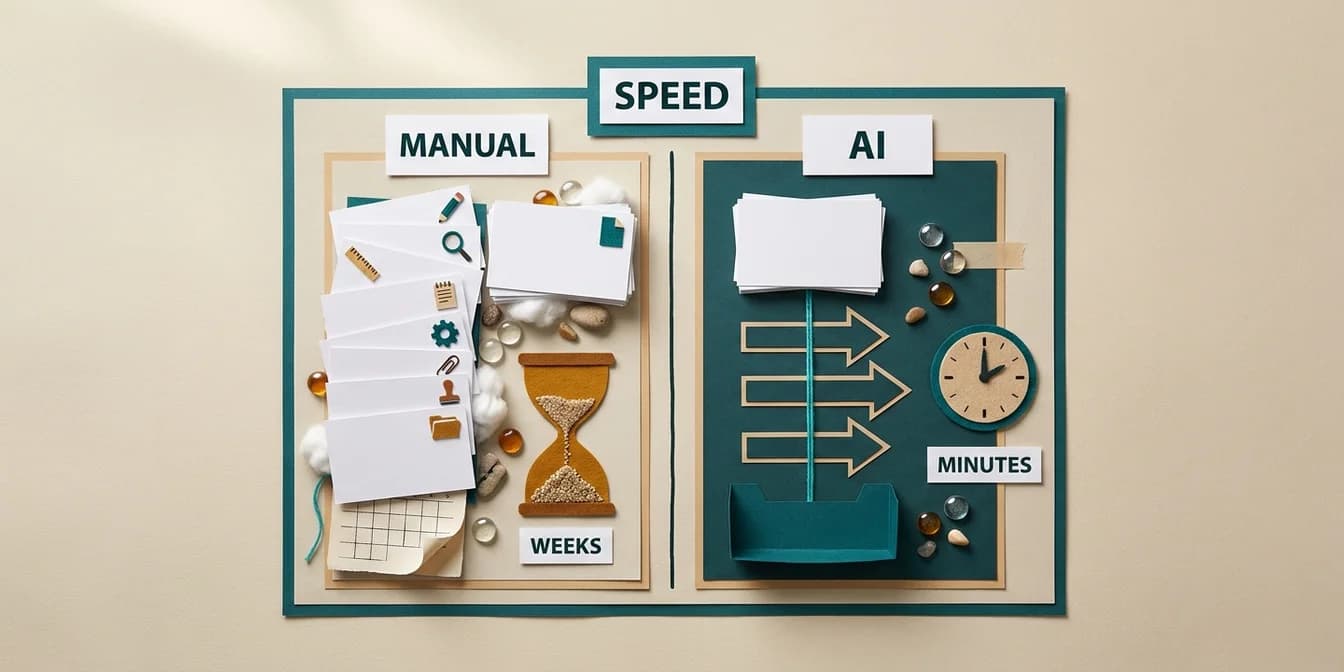
| Speed | instant | 15–30 min/product | 1,000 texts in minutes |
| Uniqueness | duplicate content | high | high (with a good prompt) |
| Scaling | unlimited, but worthless | breaks past 200 products | linear to 100,000+ |
| Brand voice | none | consistent (one author) | consistent (via brand brief) |
| SEO quality | poor | strong but slow | strong + fast |
Manufacturer copy is the default for many stores, and the worst option. Manual copywriting delivers top quality but doesn't scale: at 5,000 products and 20 minutes per text, that's over 1,600 working hours. AI closes exactly that gap: manual quality at manufacturer speed, provided the input data and the prompt are right.
The key point: AI doesn't replace the copywriter, it replaces the copying. The top 20% of your revenue products still deserve a human polish. The other 80% mostly just need a unique, clean description at all.
The duplicate-content trap: use AI well, not cheaply
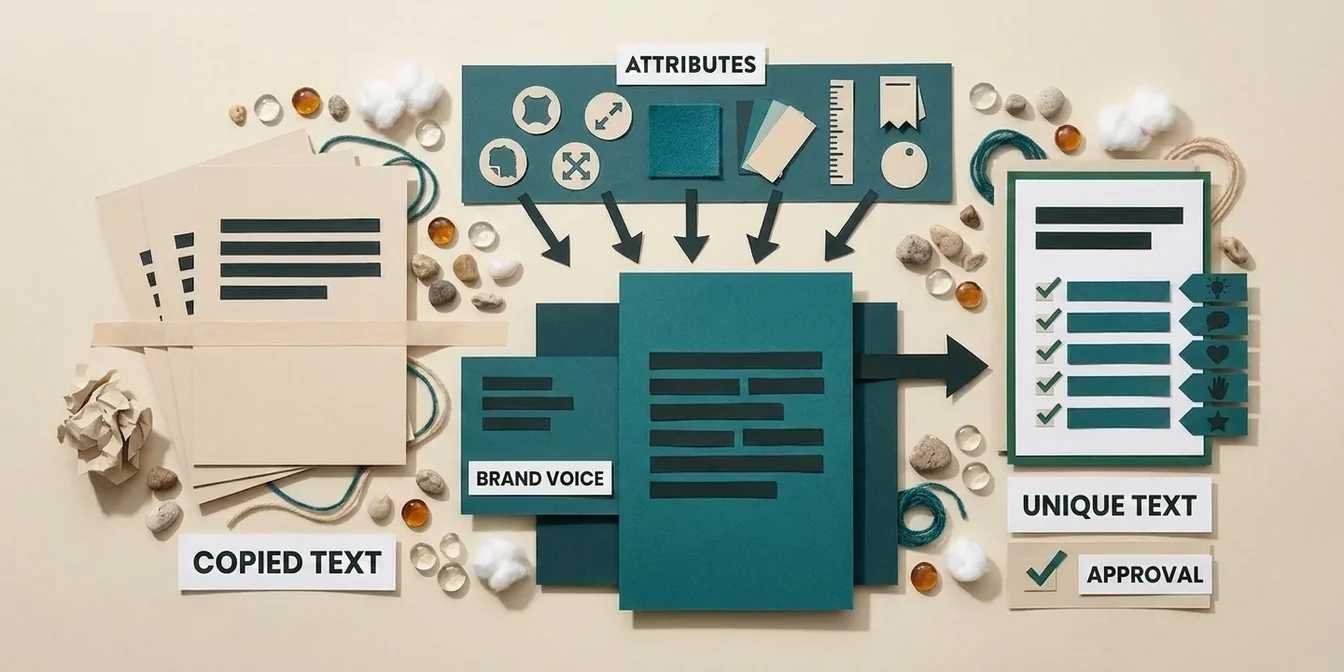
The biggest risk with AI isn't too little text: it's too much of the same text. Fire the same prompt 10,000 times with no product context, and you've swapped one duplicate-content problem for another.
Per Google Search Central, AI-generated content is not a problem, as long as it's helpful, original, and written for people rather than search engines. Google doesn't penalize "AI"; it penalizes scale without value: thousands of thin, near-identical pages with swapped keywords. That's precisely the pattern its spam policies target.
The fix lives in the input, not the model. An AI that only gets "write a description for a blue t-shirt" can only return something generic. An AI that receives material, cut, fit, occasion, care instructions, and target audience as structured attributes writes copy that exists only once. Structured product attributes are the raw material for unique text, not the language model itself.
In practice: before you generate AI copy, you close the attribute gaps. Which fields are missing, which are filled generically, where does it say "N/A"? That data foundation is, in our experience, the single biggest lever for text quality. For how to build clean feed input systematically, see our guide to AI feed optimization for Google Shopping.
Anatomy of a good AI product description
High-converting product copy follows a structure, and that structure is exactly what you hand the AI as a constraint. Four building blocks separate a spec sheet from a sales conversation.
1. Benefits over specifications
A spec sheet says "membrane: 10,000 mm water column." A sales text says "keeps you dry through hours of steady rain." The AI should translate specs into concrete everyday benefits: the single biggest conversion lever in any description. Instruct the AI in the prompt to tie every technical feature to a "so you can…" benefit.
2. Scannable structure
Nobody reads product descriptions word for word. Shoppers scan. So good AI copy delivers a short opener (2–3 sentences) followed by four to five bullet points with the strongest selling arguments. Those bullets are also what Google extracts for expanded listings and AI answers.
3. Long-tail keywords from real search language
The AI should use the terms your audience actually searches: "running shoes for overpronation," not "athletic shoe model X." These long-tail phrasings pull the most qualified clicks. Our Google Shopping product description guide goes deeper on this.
4. Honesty as a return-rate brake
Copy that overpromises sells once and gets returned twice. Disappointed returners tend to avoid the retailer afterward, so accuracy isn't a compromise: it's strategy. Tell the AI explicitly never to invent attributes that aren't in the data.
GEO: writing product copy for AI shopping
The biggest shift in 2026 isn't a new search engine: it's a new interface. Shoppers increasingly research inside ChatGPT, Perplexity, and Google AI Overviews before they ever visit a store. So your product copy has to convince humans and get cited correctly by AI assistants.
This is Generative Engine Optimization (GEO), and product copy plays by its own rules. AI assistants don't extract whole pages; they extract individual, self-contained facts. A description that states material, dimensions, compatibility, and use case as clear, attributable claims is far more likely to be picked up by an AI shopping answer than a flowery marketing paragraph with no hard facts.
In practice, GEO for product copy means structured key-value data (Material: Merino wool, Care: Hand wash 30°C, Compatible with: iPhone 15/16), clear attribute statements instead of adjective clouds, and complete product details. Leave those fields empty and you simply don't appear in the new AI shopping surfaces, no matter how elegant the prose. This is where structured AI optimization pays off twice: it fills the fields that both Google and AI assistants read.
Keeping brand voice: how to make AI not sound like AI
The most common worry about AI copy: "It'll all sound the same and not like us." Fair, but solvable. The difference is the brand brief the AI reads as a constraint.
A good brand brief defines four things: tone (formal vs. playful, first-person vs. third), forbidden words (no superlatives like "revolutionary," no empty claims), sentence length and rhythm, and sample texts the AI anchors to. With those guardrails, the same pipeline produces a sober tone for a B2B tool retailer and a playful one for a fashion store, from identical mechanics.
The second lever is the human in the loop. No serious AI system pushes copy live unreviewed. The robust workflow shows the original and the AI suggestion side by side, and you approve, edit, or reject, per product or via bulk filter. Brand control stays with you while the typing goes to the AI. At 5,000 products, that's the only path that delivers quality and speed at once.
Important: brand voice is a one-time investment. Defined once, the brand brief applies to every future optimization run, including new arrivals the AI writes automatically in the same voice.
The workflow: from raw data to finished product copy
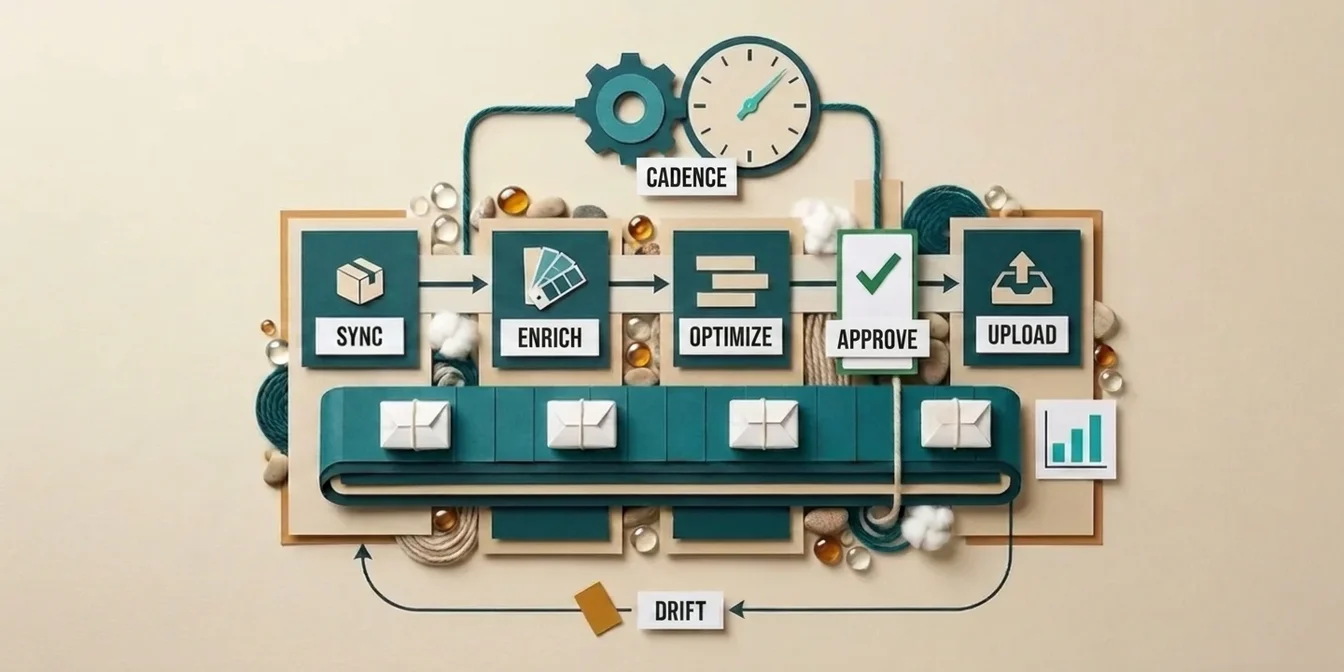
A clean AI copy process runs in four steps, and none of them is "fire a prompt and hope."
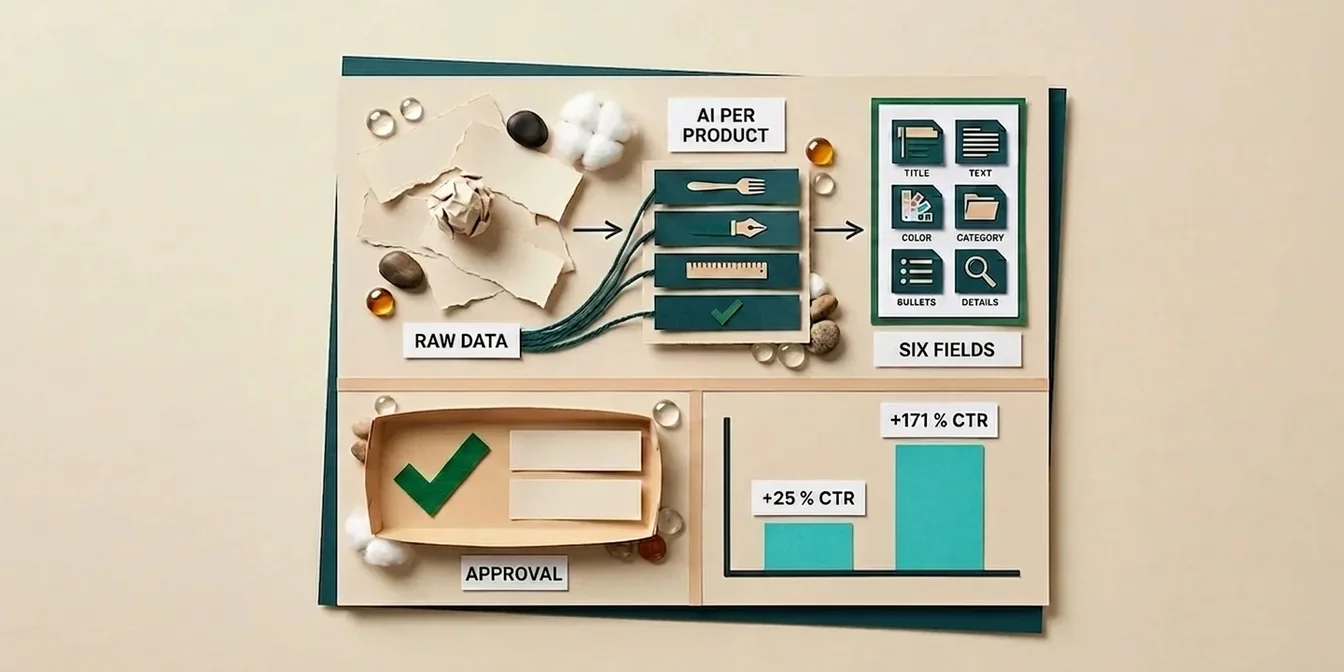
- Close the attribute gaps. Before writing, check (or extract) the missing product attributes: color, material, size, audience, use case. This data is the raw material. Missing attributes can be extracted by AI from the product page and images.
- Generate per category. Apparel needs different copy than electronics. A good system detects the product category and applies a category-specific strategy: for apparel brand + fit + material, for electronics model + compatibility + spec.
- Review the output. Original vs. AI suggestion side by side, approve or adjust. With filters like "all apparel products, quality score above 85," you handle thousands of approvals in seconds.
- Ship it without risk. Approved copy goes into your store or as a supplemental feed into Merchant Center. The feed route leaves your original feed untouched (how supplemental feeds work).
This workflow scales linearly: effort per product drops with catalog size while quality per product holds constant. That's exactly why AI copywriting isn't just cheaper past a certain catalog size: it's the only practical option.
When AI product descriptions pay off and when they don't
AI is worth it when …
- You have more than 100 products (below that, many stores write faster by hand)
- Your copy currently comes from the store export or manufacturer feed (meaning generic)
- Your catalog changes regularly (AI writes new arrivals automatically in the brand voice)
- You sell across multiple categories and need a different copy logic per category
- You sell into multiple markets (US, UK, AU, EU) and want localized copy, not 1:1 translation
AI isn't worth it when …
- You have under 50 products and can hand-tune them all
- Your products carry heavy regulation (pharmaceuticals, financial products) and every line needs legal review
- You already have professionally copywritten premium content where any deviation dilutes the brand
For the typical mid-market store with 200 to 50,000 products, AI product copy is the single largest content lever available, often bigger than a site relaunch or a budget increase. Before you invest, our feed management tools comparison 2026 is the fastest way to see the approaches side by side.
How FeedOptimizer.AI implements AI product descriptions
FeedOptimizer.AI is purpose-built for AI-generated product copy on Google Shopping: exactly the surface where bad copy is most expensive. The pipeline is built AI-first:
- Category-specific generation across 12 product domains, no one-size-fits-all copy
- Attribute extraction fills missing fields (color, material, size) from the product page and images before writing
- Custom prompts per feed: your own instructions on tone, forbidden words, and sentence length feed into every optimization run as a constraint
- Workbench review with before/after comparison, bulk approve, and inline edit
- Supplemental Feed upload directly into Merchant Center, your original feed stays untouched
- Quality Score per product showing which fields still cost you copy quality
Unlike generic text generators that spit out a single block of prose, FeedOptimizer.AI optimizes title, description, bullet points, and structured product details together: the fields that drive both conversion and visibility in AI shopping answers. To understand how the AI pipeline works under the hood, see the AI feed optimization practitioner's guide.
Frequently asked questions
Does Google penalize AI-generated product descriptions?
No. Per Google Search Central, AI content isn't a ranking problem as long as it's helpful, original, and written for people. What gets penalized is scale without value and near-duplicate pages. AI copy built on real, product-specific attributes meets Google's bar, a copied manufacturer description does not.
How do I keep all AI copy from sounding the same?
Through two levers: structured, product-specific input data (material, cut, use case) and a brand brief that defines tone and forbidden words. The richer the attribute data, the more unique the text. Generic copy only comes from generic inputs.
What does an AI product description cost per product?
At FeedOptimizer.AI on the 10,000 band (10,000 products for $149/month), about 1.5 cents per product. For comparison, a copywriter charges $9–$16 per description. AI copy is, depending on band, several hundred times cheaper, at comparable structural quality.
Do better product descriptions actually reduce returns?
Yes. 56% of shoppers have returned something because it didn't match the description (PowerReviews, 2022). Precise, honest copy that invents no attributes lowers the "didn't-match-the-description" returns and protects your repeat-purchase rate at the same time.
Do I have to approve every AI text individually?
No. With bulk filters by category or quality score, you approve thousands of texts in seconds. Critical or high-margin products you review individually; the rest run through bulk approve. Effort per product drops with catalog size.
Conclusion: AI product descriptions are a 2026 baseline, not a bonus
Product copy decides conversion, returns, and visibility, and 87% of shoppers call accurate product content very important to their buying decision (Salsify via Retail TouchPoints, 2017). Run that with copied manufacturer text and you forfeit the single most visible lever you have.
The three takeaways:
- The input decides, not the model. Structured product attributes are the raw material for unique copy. Keep the data clean and you get unique text; feed in "blue t-shirt" and you get generic.
- GEO is the new requirement. In 2026, product copy has to be quotable by AI assistants too: with hard, structured facts instead of adjective clouds.
- Human-in-the-loop stays mandatory. Only a review workflow protects brand voice and accuracy. Fully automated upload without approval doesn't scale.
Start with the top 20% of your highest-revenue products, let AI write the copy, review it, ship it. Compare conversion and return rate after four weeks, then scale to the rest of the catalog.
Optimize your first 200 products free with : no credit card, no risk, no changes to your original feed.