How much faster is AI than manual feed optimization?
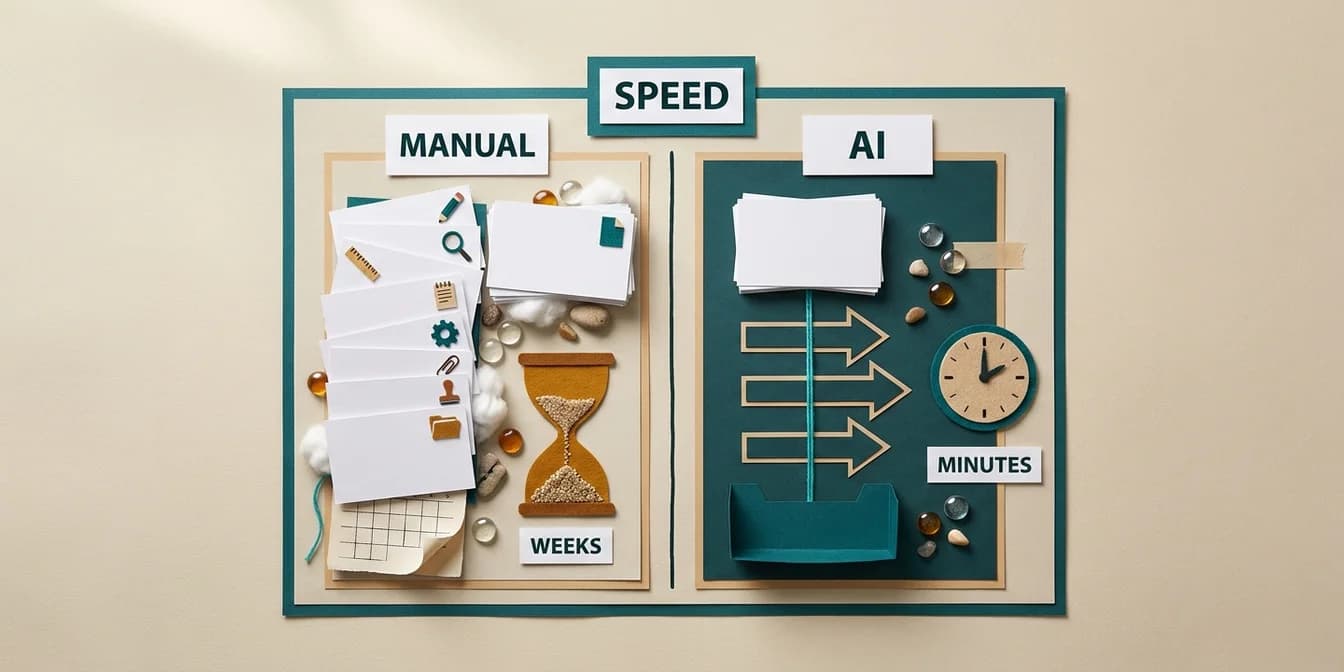
At a six-figure SKU catalog, manual attribute upkeep rarely covers more than a small share of the active catalog, spread across multiple spreadsheets, with a days-long setup per product. AI-generated attributes run in parallel across the whole catalog instead of row by row, and that's what shifts coverage from a fraction of the catalog to the majority of it. Content that manual feed optimization used to take weeks to produce now ships in seconds with AI.
That difference isn't a gradual improvement, it's a different cost curve. Manual optimization costs roughly the same amount of time per product whether you're on item 10 or item 10,000. AI optimization, once set up, costs almost nothing per additional product. That curve decides whether your feed is done by tonight or drags into next quarter.
The math no feed tool shows you
Take a mid-size feed of 2,500 products. An experienced ecommerce manager needs, checking competitor listings, respecting character limits, applying category-specific keyword order, proofreading, roughly 4 minutes per product for a clean title. That's a deliberately conservative assumption, not a number lifted from someone else's study, run it against your own pace and see.
4 minutes times 2,500 products is 167 working hours, more than four full weeks for one person, and that's just titles. Descriptions, attributes, product highlights, and category mapping come on top. At 10,000 products it's already 667 hours, roughly four months full-time. Meanwhile the feed keeps growing: new products every week, prices and availability shifting every month. Manual upkeep doesn't lose because people work slowly. It loses because the math stays linear while the catalog grows.
An AI pipeline reads the same 2,500 products in parallel batches, category by category, and writes title, description, and attributes in a single run. The wait time depends on the underlying model's API latency, not on how many products are in the queue, because multiple batches run at once.
Measured, not estimated: in a single optimization run on 26 July 2026, FeedOptimizer.AI rewrote titles, descriptions, and attributes for 71,346 products of a Swiss online shop in 30 minutes, roughly 2,400 products per minute. Done by hand at 4 minutes per product, the titles alone would take about 4,750 working hours.
Where AI actually wins on speed
Three areas where the time advantage is measurable, not just claimed.
Title generation. Keyword-rich titles aligned with actual search queries are widely considered one of the most effective CTR levers in Google Shopping. The AI's time advantage here doesn't come from extra thinking time, it comes from applying the same rule consistently across thousands of products, something a human stops doing with discipline somewhere past product 200. For the rules themselves, see our guide to optimizing Google Shopping titles.
Description copy. Writing 500 descriptions by hand at a realistic pace would take several weeks. An AI pipeline delivers a draft for all 500 in a single pass, in minutes instead of weeks.
Attribute extraction. Pulling color, material, gender, and size out of product copy or images is the task that takes longest manually, because it means flipping between the product page and the feed column. That's exactly where automation makes the biggest jump in catalog coverage, as covered in our Google Shopping feed attributes guide.
Where manual work still wins
AI isn't the right answer everywhere, and an article that pretends otherwise is a sales brochure, not a comparison.
Deterministic transformations belong in feed rules, not a language model. Currency conversion, appending a required prefix, normalizing GTIN format: these are if-then operations with zero room for interpretation. AI can do them, but slower and with a residual amount of variance a rule simply doesn't have.
Brand voice on edge cases. A prompt nails the tone almost every time. The one outlier, a niche product with sensitive phrasing, a legally tricky marketing claim, needs a human to sign off. That's why human-in-the-loop review stays mandatory, not a nice-to-have.
New, ambiguous categories. When a product doesn't match any of the trained category patterns, a highly specialized B2B replacement part with no public comparison data, for example, the first classification needs human judgment. AI can take over the pattern afterward, but a person sets the first precedent.
The line isn't "AI good, human bad." It's between repeatable rule logic and one-off expert judgment. Feed rules and AI solve different problems, as we cover in detail in our guide to AI feed optimization.
The hybrid workflow that combines both speeds
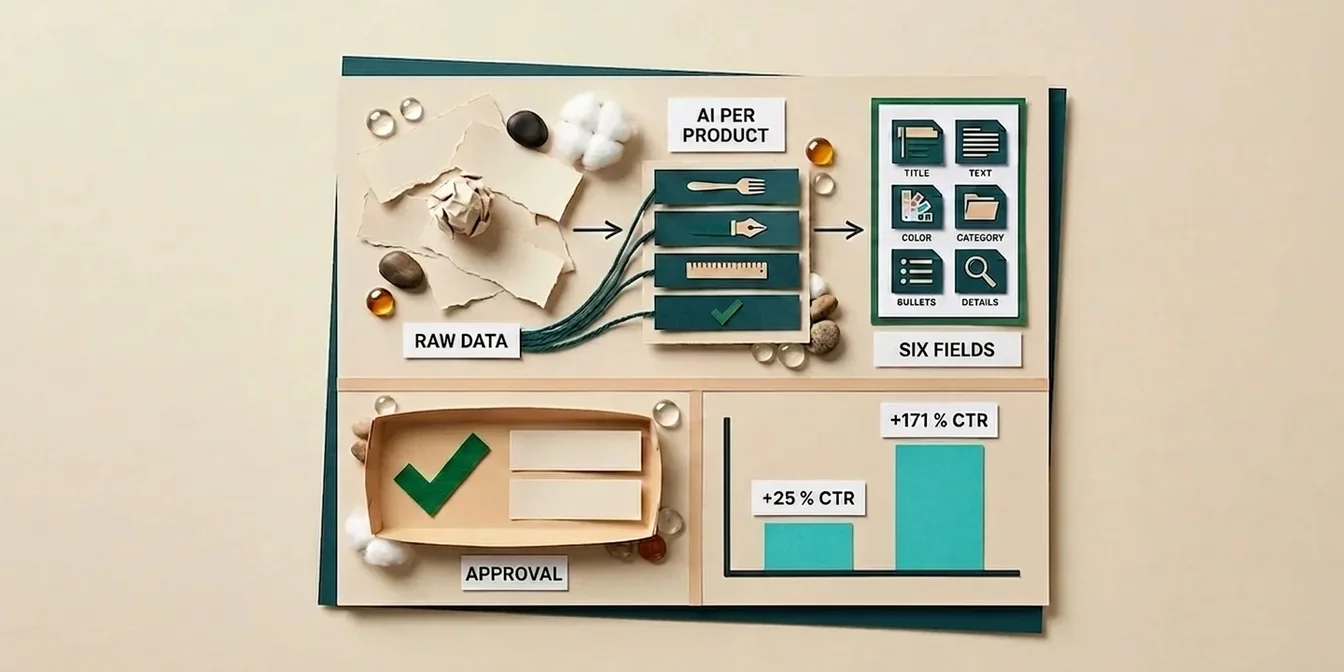
The fastest workflow isn't either pure approach, it's a fixed order: feed rules handle the mandatory transformations first (compliance, format, required fields), then the AI pipeline runs over the cleaned feed and produces title, description, attributes, and category in one batch pass, then a human reviews the suggestions in a dashboard before anything goes live.
At FeedOptimizer.AI, that looks like this in practice:
- Batch optimization across multiple parallel workers, category-specific prompts instead of one generic template for all 12 product domains
- Workbench review with a before/after diff, bulk-approve above a score threshold, and individual review for the outliers
- Supplemental feed upload, your original Merchant Center feed stays untouched, with a built-in fallback if a suggestion gets rejected
- Bulk optimization for 100 to 10,000-plus products in a single run, without the wait time per product climbing linearly
The difference from pure automation without review: a human still decides what goes live, just in seconds per product instead of minutes. That's what turns the 167 hours from the math above into an afternoon of review work.
Test the difference on your own feed. , no credit card, no risk, and your original feed stays untouched.
Frequently Asked Questions
Does AI feed optimization beat an in-house team in practice?
For generation, yes. For approval, it depends on the review process. A team that reviews every single suggestion one by one gives back part of the speed advantage. With bulk-approve above a score threshold, the time savings hold because only the outliers need individual review.
At what catalog size does AI optimization pay off?
Somewhere around 500 to 1,000 products, the math visibly tips toward AI: titles alone already take 33 to 67 hours, and descriptions, attributes, and category mapping add substantially more on top. Under 100 products, the gap is often small enough that either path stays workable.
Do I lose control if AI writes my copy?
No, as long as a review step sits before upload. The supplemental feed approach leaves your original untouched, and human-in-the-loop review before approval stops a single bad suggestion from going live.
Can AI save time on very small feeds too?
Yes, but the absolute time saved is smaller. At 50 products you save roughly 3 hours instead of 167; setup plus review overhead weighs relatively heavier against a small catalog than a large one.
What happens when my feed changes every week?
New products flow into the pipeline automatically once they're synced. Already-optimized products stay frozen until you actively trigger a re-optimization, so an overnight sync never silently overwrites an optimization that's working.
Conclusion: the speed advantage is a cost curve, not a claim
Manual feed upkeep costs linearly. AI upkeep costs nearly flat after setup. At 2,500 products, that's 167 hours against a batch run plus an afternoon of review. The gap widens with every product you add.
Three takeaways:
- Run the math on your own case. Four minutes per product times your catalog size tells you immediately whether you're looking at hours or weeks.
- AI doesn't replace feed rules, it complements them. Deterministic transformations stay a rules job, content quality becomes an AI job.
- Review stays the bottleneck you have to design on purpose. Bulk-approve above a score threshold keeps the time savings; individually reviewing every suggestion eats them right back up.