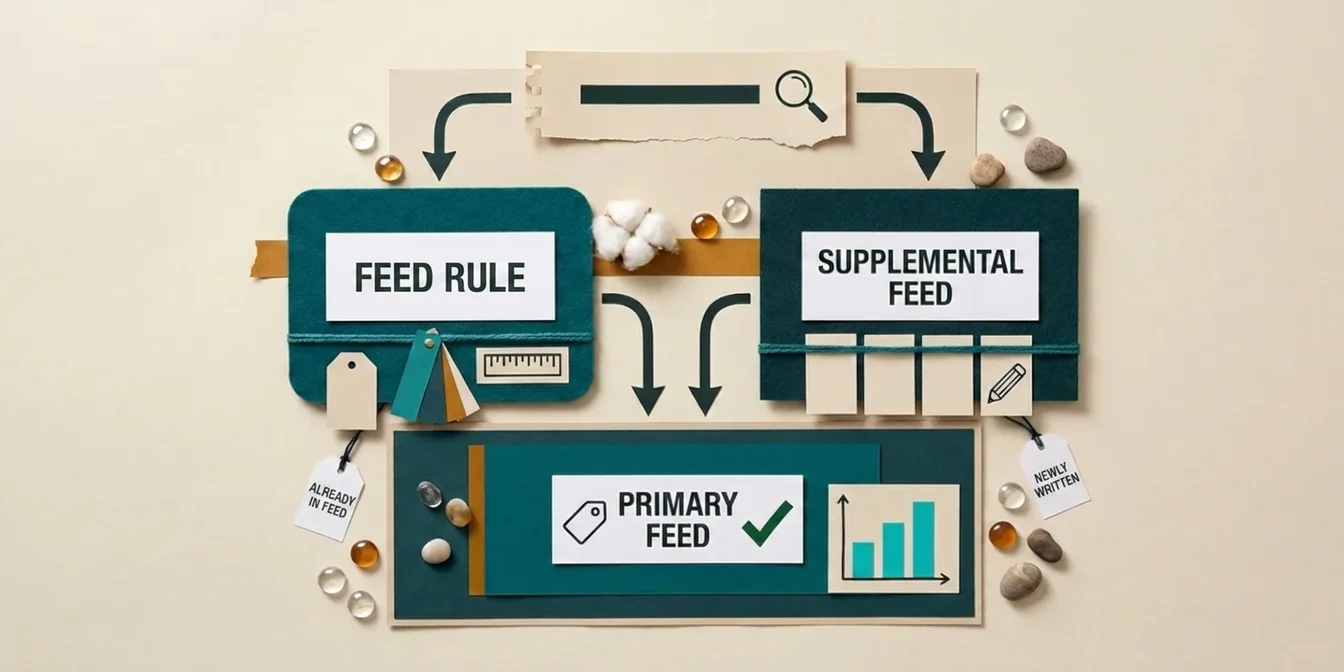
Most merchants searching for a Channable alternative aren't actually unhappy with their data pipeline. The real frustration usually sits one level up: the product copy that ends up on Google doesn't pull the clicks it could. You don't need to cancel Channable to fix that. FeedOptimizer.AI isn't a second pipeline, it's an optimization layer that sits on top of your existing feed: Channable keeps generating and distributing the feed exactly as before, we rewrite the copy and push it back into Merchant Center as a supplemental feed. Your Channable setup stays untouched.
This comparison covers what each tool does well, what Channable's own AI module costs, and when the layer on top is worth it.
The difference in one sentence
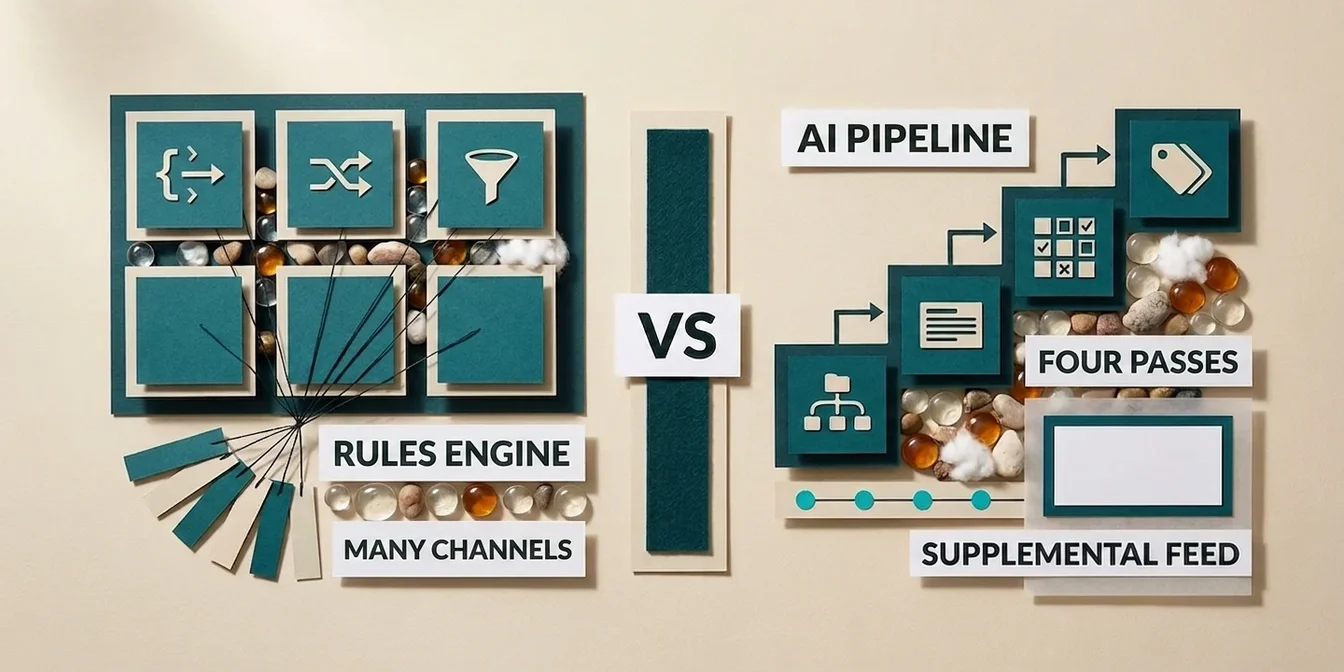
Channable is a rule-based feed management system with PPC automation for over 3,000 channels. FeedOptimizer.AI is the AI optimization layer for exactly one channel: Google Shopping. The two compete far less than the search results suggest. Channable answers the question of how your product data reaches many channels. FeedOptimizer.AI answers whether the copy inside that data earns clicks on Google. One doesn't replace the other, it builds on top of it: our optimization requires an existing primary feed, and that feed can come from Channable, from your store platform, or from any other source.
What Channable does well
Channable is the right choice if you sell on many channels at once. The platform combines feed management, marketplace integration, and PPC automation in one tool.
The Dutch company (founded 2014, headquartered in Utrecht) serves over 12,000 brands and 1,300 agencies by its own count, including IKEA, Vodafone, and MediaMarkt, and processed around 23 million orders through the platform in 2025. On G2, Channable holds 4.5 out of 5 stars (54 reviews, as of July 2026), with particularly strong marks for support.
Its strengths in detail:
- Channel coverage: Over 3,000 sales channels and marketplaces, from Google and Meta to Amazon and bol.com
- PPC automation: Rule-based bidding strategies straight from the feed platform
- Rule engine: Shared rules can be reused across multiple channels
- Repricer: Built-in automatic price adjustment for Amazon and bol
- Smart Categorization: ML-assisted mapping to the right Google category
Channable also offers generative AI copy: its "AI Text Generation" suggests titles and descriptions, with field selection, custom instructions, and per-suggestion approval. How that module is billed, though, is where the two approaches split most clearly.
What Channable's AI module costs
According to Channable's own help center (as of August 2026), AI Text Generation comes with four conditions worth knowing before you decide:
- It requires the Core Pro plan, the highest tier of the Core plan.
- It requires your own Gemini or OpenAI connection. AI usage runs through your own account, and you pay the model provider directly.
- You're billed at generation time, not at approval time. Channable states explicitly that costs apply even if you discard a suggestion afterwards, and that every re-run counts as a new request with new costs.
- Channable itself advises against generating copy for thousands of items at once to avoid high costs.
None of this is hidden fine print; it's documented transparently, and for targeted copy work on individual product lines the model is perfectly reasonable. But it means one thing: using Channable to generatively rework your entire catalog works against the tool's own cost structure.
At FeedOptimizer.AI, the AI isn't a module, it's the product. Every plan includes it, there's no API key of your own, no cost per generation, and no charge for re-runs. A suggestion you reject costs you nothing. And the catalog doesn't run in batches, it runs in one pass: in our production runs in August 2026, roughly 76,000 products were optimized in about half an hour.
Volume alone would be no argument
Pushing an entire catalog through a language model unchecked doesn't produce better feeds, it produces invented attributes and claims your product never made. That's exactly why quality control at FeedOptimizer.AI isn't an afterthought but the core of the pipeline:
- The Google category can't be made up. The AI picks from a vetted candidate list; it cannot hallucinate a category.
- Every prompt change runs through a blind quality comparison with a hard veto: a change that raises fill rates but introduces unsupported values gets rejected.
- Deterministic validation rules flag unsupported norm and certification claims in titles before anything is uploaded.
- Nothing goes live without your approval. Every change sits in the workbench for review, individually or in bulk, and is fully reversible.
The question isn't Channable or us. Channable is a strong pipeline, and that's exactly why we don't touch it: we add the layer on top that turns existing product data into copy that earns clicks. The feed stays, the setup stays, only the copy gets better.
Dennis Gerich, Founder & CEO, FeedOptimizer.AI
Supplemental feed: how the two mesh
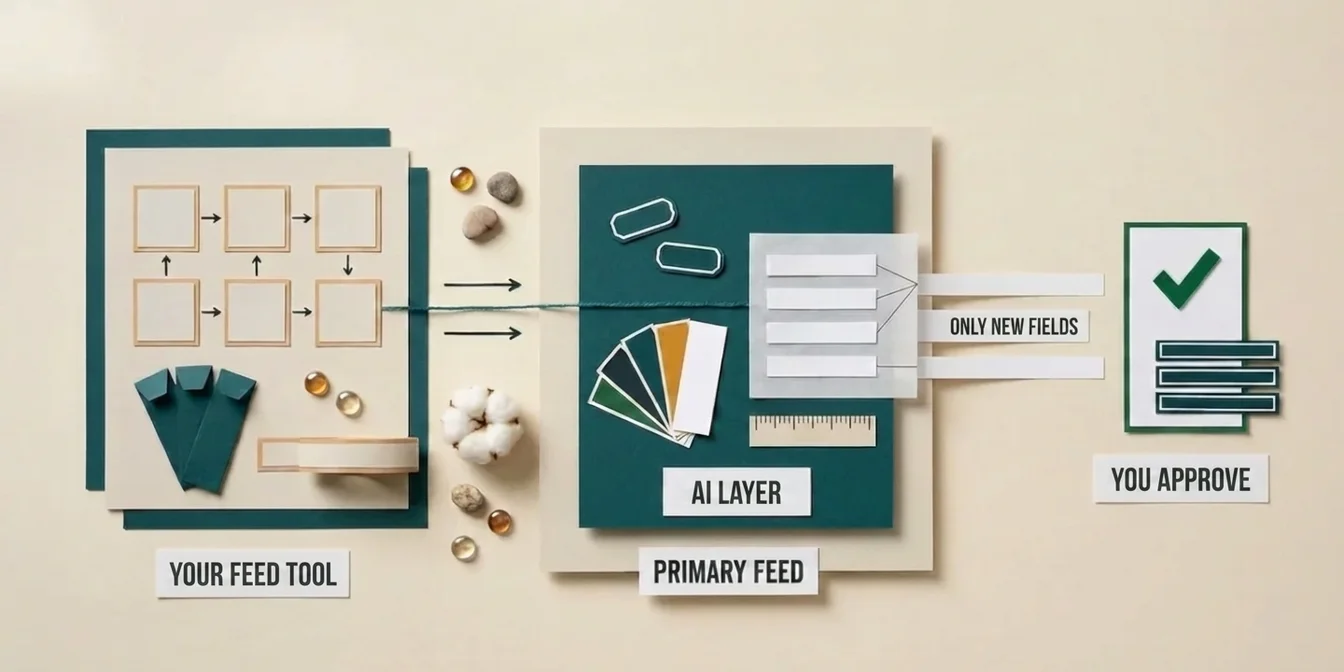
Technically, the combination works through a mechanism Google itself provides for this purpose: the supplemental feed. Channable (or your store platform) delivers the primary feed with all required data. FeedOptimizer.AI reads the products from Merchant Center, optimizes titles, descriptions, and attributes, and pushes only the improved fields back as a supplemental feed. Google merges both sources, the optimized copy wins, and your original feed stays unchanged.
In practice that means: no export, no import, no changes to your Channable rules or campaigns. Turn the layer off and the original state applies again. Channable actually offers a related mechanism itself, in a narrower scope: its separate CSS product pushes manually approved individual titles into Merchant Center via its own supplemental source (Title Optimizer). The difference is scope: individual, hand-confirmed titles there, the entire catalog including descriptions and attributes here.
Pricing compared
The biggest difference isn't the price itself, it's how predictable it is. FeedOptimizer.AI bills by product count, one price per tier, everything included. Channable bills modularly: items package plus Core module plus optional add-ons for marketplaces, PPC, and creatives, plus the cost of your own model connection when using AI text generation.
| Feed size | FeedOptimizer.AI | Channable |
|---|---|---|
| Entry (up to 200 products) | $0 (Free, no time limit) | No free tier, only an unlimited-time trial with no credit card (channels can't be activated on it) |
| ~2,000 products | $49/month | Items package + Core plan, priced modularly (current rates on channable.com) |
| ~10,000 products | $149/month | Items package + Core plan, priced modularly (current rates on channable.com) |
| ~100,000 products | $499/month (custom pricing above that) | Items package + Core plan + separate modules for marketplaces/PPC/creatives (current rates on channable.com) |
Channable doesn't publish a fixed price table: it combines items package, Core plan, projects, and channels into a modular bundle whose final price depends on the combination you pick. Channable's pricing page blocks automated access, so we don't quote figures here that we couldn't verify against the source directly. For your exact terms, Channable's current pricing page is what counts.
$149 is what FeedOptimizer.AI charges for 10,000 products, complete, with no add-on modules and no AI connection of your own. One thing matters for context: the two prices buy different things. Channable's price buys distribution across many channels; ours buys copy quality on one channel. If you need both, the two line items sit next to each other, not against each other.
Features side by side
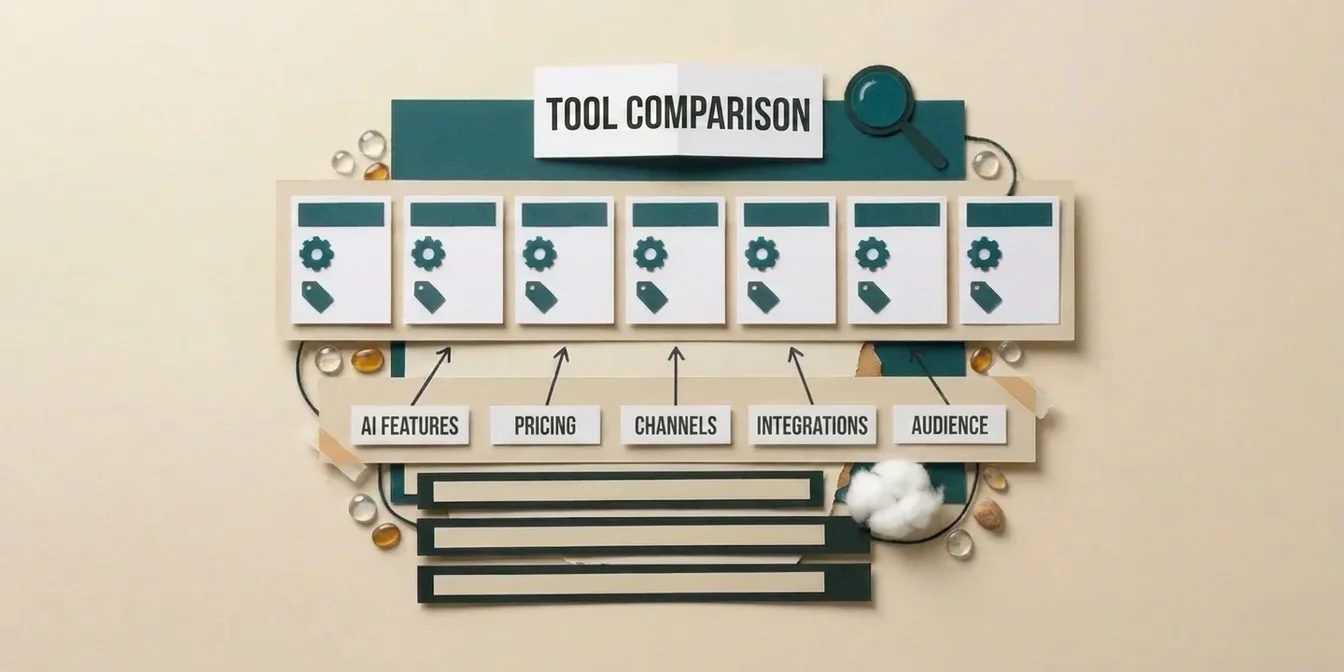
| Feature | FeedOptimizer.AI | Channable |
|---|---|---|
| Generative AI for titles/descriptions | Yes, included in every plan | Core Pro plan only (add-on module, own AI connection required) |
| Cost per AI generation | No | Yes, via your own Gemini/OpenAI connection (including discarded suggestions) |
| Custom AI prompts | Yes | Partial (field selection + instruction text on Core Pro) |
| Before/after preview | Yes | Partial (per-suggestion approval, no diff view) |
| Supplemental feed hosting | Yes, entire catalog | Partial (CSS product/Title Optimizer only, manual per title) |
| Free tier | Yes (200 products) | No |
| Flat pricing | Yes | Partial (modular) |
| Multi-channel distribution | No (Google Shopping only) | Yes (3,000+ channels) |
| PPC automation | No | Yes |
| Self-service | Yes | Yes |
When is Channable alone enough, and when does the layer pay off?
Channable alone is enough if...
- Your titles and descriptions are already well maintained and your leverage sits in distribution
- You mainly sell through marketplaces and many channels, and Google Shopping is just one of them
- You only need AI copy occasionally for individual product lines and are happy to maintain your own Gemini or OpenAI connection
- Your team has rules and mappings under control and the feed runs clean
The layer on top pays off if...
- Your titles come raw out of the store platform and nobody on Google searches for them: better product titles translate directly into more clicks
- You want to improve the entire catalog, not a sample, with costs you can predict
- You don't want to configure an AI connection, maintain prompts, or pay per generation
- You want to see and approve every change before it goes live, with a rollback that costs nothing
Running both is the normal case
The combination isn't a workaround, it's the setup both tools are built for: Channable for structure and distribution, FeedOptimizer.AI for copy quality on Google Shopping. There's no migration effort and no conflict, because the layer works through Merchant Center and never touches your Channable project.
Measure first, then decide
Before you rebuild anything, look at where your feed stands today: the free Feed Check connects to your Merchant Center and scores every single product in your catalog, with a quality score per product and concrete example rewrites of your weakest titles. That shows you in black and white what your current setup delivers, and whether a layer on top is worth it for you. For the full feature comparison, our dedicated comparison page has all the details.
Start free with and optimize your first 200 products, no credit card, no risk.
Frequently asked questions
Is FeedOptimizer.AI an alternative to Channable?
No, it's a complement. FeedOptimizer.AI requires an existing primary feed and optimizes its copy through a supplemental feed in Merchant Center. Channable remains your pipeline for mapping, marketplaces, and PPC. Both run in parallel without getting in each other's way.
Can Channable generate AI titles too?
Yes, on the Core Pro plan: Channable's "AI Text Generation" suggests titles and descriptions, including field selection, instruction text, and per-suggestion approval. The difference: the feature requires your own Gemini or OpenAI connection, bills per generation (including discarded suggestions), and Channable itself advises against generating copy for thousands of items at once. At FeedOptimizer.AI, full-catalog generation is normal operation, included in the flat price.
Do I have to cancel Channable to use FeedOptimizer.AI?
No. The layer works through Google Merchant Center and changes neither your Channable feed nor your rules or campaigns. Connect Merchant Center, optimize, approve: your Channable setup keeps running unchanged, and if you switch the layer off, the original state applies again.
Is Channable cheaper than FeedOptimizer.AI?
The two prices buy different things, so they don't compare directly. Channable prices modularly (items package, Core plan, modules, plus your own model connection for AI copy); the figures are on channable.com. FeedOptimizer.AI costs $149/month for 10,000 products, everything included. If you only need distribution, Channable alone does the job. If you want copy quality across the whole catalog, budget the layer as its own line item.
Does FeedOptimizer.AI support channels other than Google Shopping?
Not currently. FeedOptimizer.AI focuses entirely on Google Shopping and Merchant Center. Multi-channel support is on the roadmap; for maximum channel coverage today, Channable is the right choice.