What's New in Google Merchant Center Next in 2026?
Merchant Center Next is no longer "the new interface" in 2026. It's the only Merchant Center. And this year, several hard changes land at once: the old Content API shuts down permanently on August 18, 2026, the feed gets new required and optional attributes (video, minimum order value, higher image resolution), and Google now shows you, for the first time, how your products perform across AI Mode in Search, AI Overviews, and the Gemini app.
Lose track of these, and the consequences are concrete: deactivated product listings, feed warnings, or missed visibility on the new AI shopping surfaces. This guide bundles every relevant Merchant Center Next 2026 feature, with a deadline table, sources, and a clear action list per feature.
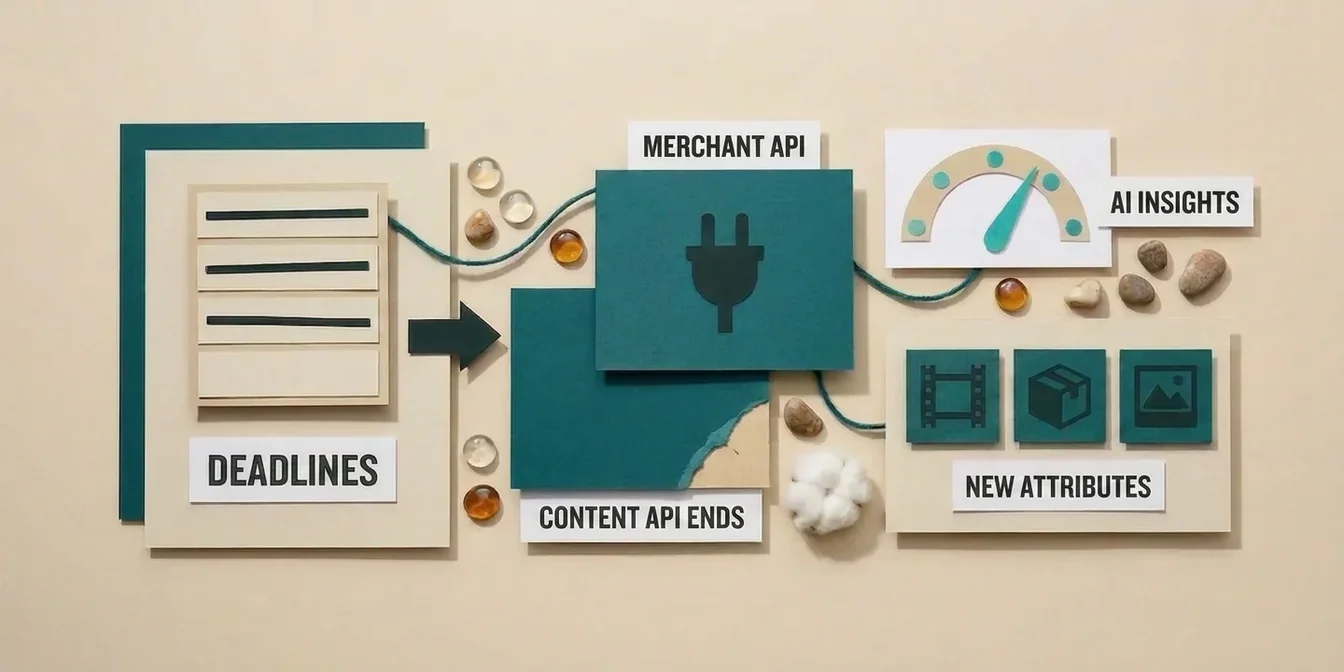
Every 2026 Deadline at a Glance
The most painful change isn't a new feature; it's a shutdown date. This table shows what happens when, and what you need to do about it.
| Date | What happens | Action |
|---|---|---|
| Feb 28, 2026 | Merchant API v1beta shut down (beta version of the new Merchant API) | Migrate to v1 |
| Apr 14, 2026 | New attributes available; image & video warnings start | Extend your feed |
| Jun 30, 2026 | video_link starts serving + quality validation begins | Submit videos |
| Aug 18, 2026 | Content API for Shopping shuts down permanently | Migrate to Merchant API |
| Jan 31, 2027 | 500×500 px minimum image resolution enforced | Upscale images |
Per Google's own developer documentation, August 18 is not a suggested target; it's a hard shutdown. Any brand still running on the Content API loses its product listings that day. Treat the table as a mandatory roadmap, not a recommendation.
The Content API Shutdown: Migrating to the Merchant API
Google is fully replacing the Content API for Shopping with the new Merchant API, and switching off the old interface on August 18, 2026. Anyone who sends their feed or product data to Google programmatically or through a tool is affected.
The Merchant API isn't an update; it's a rebuild: modular, resource-based, and built for large catalogs and multiple data sources. Instead of one monolithic endpoint, you now get individually addressable sub-APIs (products, data sources, accounts, reporting), enabling more efficient partial updates and better scalability.
How to check if you're affected: In Merchant Center, go to Settings → Data Sources and look at the Source column. If a data source shows "Content API," you must migrate before August 18. The good news: if you use a modern feed tool, your provider usually handles the migration behind the scenes, but ask actively instead of assuming. Manual feed uploads and Google Sheets feeds are not affected by the shutdown.
New 2026 Feed Attributes: Video, Shipping, and Images
As of April 14, 2026, several new product attributes are available: three for shipping, one for video, and a tightened image requirement. Some are optional, some carry a hard enforcement date. Every detail matters here, because feed warnings turn into disapprovals fast.
Product-Level Shipping Attributes
handling_cutoff_time: sets the daily time by which an order must be placed to still be processed the same day. Without it, Google defaults to 8 AM PST, which is wrong for most merchants.minimum_order_value: defines the minimum spend required to order a product with a given shipping setup.- Loyalty shipping labels: new sub-attributes (program label + tier label) to flag loyalty-based shipping benefits per product.
Video Attribute
The new video_link attribute is optional and accepts multiple values. You can submit product videos as of April 14; they have been serving since June 30, 2026, when quality validation also kicked in. For visually driven categories (apparel, furniture, sporting goods), this is an early edge; most competitors aren't supplying video yet.
Higher Minimum Image Resolution
Google is raising the minimum image resolution to 500×500 pixels. Warnings have appeared since April 14, 2026; enforcement begins January 31, 2027. Google recommends 1,500×1,500 pixels for best performance. If you're still serving old 250px thumbnails, schedule the re-export project now; across thousands of SKUs, that's not a same-day job. For how to avoid feed warnings systematically, see the guide to common Google Shopping feed errors.
AI Performance Insights: How Your Products Perform in AI Mode
With AI Performance Insights, announced May 27, 2026, Google shows for the first time how your products surface across AI Mode in Search, AI Overviews, and the Gemini app. The report is rolling out over the coming months in the United States, Canada, Australia, India, and New Zealand.
The report has four components:
- Share of Voice: your brand visibility on AI-driven shopping journeys, benchmarked against comparable merchants.
- Shopping Funnel Performance: your share of voice reported separately for discovery, evaluation, and purchase (three independent figures, not a split of one total). In Google's own example, it's 18.1% in discovery, 33.7% in evaluation, and 9.3% in purchase.
- Product Term Insights: popular conversational search terms plus your share of voice for them.
- Product Attribute Completeness: flags products missing structured attributes users frequently search for (color, style, material).
Why this matters shows in Google's own numbers from the announcement: AI Mode has surpassed 1 billion monthly active users globally, and the Shopping Graph holds more than 60 billion product listings, with over 2 billion refreshed every hour. On top of that, AI Mode queries are three times longer than traditional searches on average, and one in six uses voice or images. Translated: complete, structured attributes aren't a nice-to-have anymore; they're the prerequisite for showing up in those long, specific AI queries at all.
The fourth component, Product Attribute Completeness, is the real wake-up call. Google now tells you in plain sight which attributes are missing for your products to match in AI answers. That's not a courtesy; it's a ranking signal spelled out for you.
– Dennis Gerich, Founder & CEO, FeedOptimizer.AI
Conversational Attributes: The Feed for AI Search
Conversational Attributes are optional, structured attributes that explain your products' nuances to AI; they complement the standard product data specification and don't affect your products' approval status. Google uses them to better match products with conversational queries across AI Mode, Gemini, and other AI surfaces.
There are six new attributes:
- Question and answer: pre-written Q&A about the product
- Document link: a link to supporting documents (e.g., size charts, spec sheets)
- Related product: related products
- Item group title: the product group's title
- Variant option: a variant option (e.g., color, size)
- Popularity rank: popularity rank within your catalog
You can submit them via a supplemental data source (recommended), your primary data source, or the Merchant API. The supplemental route is safest because your original feed stays untouched; see exactly how that works in the supplemental feed guide. Since these attributes don't touch approval status, you can test them risk-free.
More Changes: Agencies and Automatic Data Extraction
Two structural changes round out the 2026 picture: a dedicated agency center and automatic product data extraction from your website.
Merchant Center for Agencies launched in the U.S. and Canada in March 2026 and has been generally available worldwide since May 11, 2026: a central command center to manage an entire client portfolio in one place instead of jumping between accounts.
Automatic product data extraction pulls titles, descriptions, prices, and images directly from your website, built for merchants without a structured feed. It's convenient for getting started, but with a caveat: what Google extracts automatically is rarely as precise as a deliberately optimized feed. Titles and attributes especially deserve control, because product title structure decides visibility.
What You Should Do Right Now
Individually, each feature looks manageable; together, they add up to a real workload. This order prioritizes by deadline and risk:
- Check your migration status (top priority). Settings → Data Sources → "Source" column. If it says "Content API," sort out the migration with your feed tool or developer before August 18.
- Audit your images. Identify everything under 500×500 px and set up a re-export project before enforcement hits on January 31, 2027.
- Close attribute gaps. Color, material, size, style: exactly the fields Google now flags in the completeness view. More in the guide to product descriptions.
- Test Conversational Attributes. Roll them in risk-free via a supplemental feed, starting with your highest-revenue products.
- Add video for visual categories. If you sell apparel, furniture, or sporting goods, populate
video_linknow; the edge is real while competitors hesitate.
Doing all of this by hand across thousands of products is exactly where AI feed optimization earns its keep, here's how that works.
Frequently Asked Questions
Do I really have to migrate before August 18, 2026?
Yes, if any of your data sources runs through the Content API for Shopping. Google shuts the interface down permanently that day, and affected product listings disappear. Check your status under Settings → Data Sources. Manual uploads and Google Sheets feeds aren't affected; only API connections are.
What's the difference between Merchant Center and Merchant Center Next?
Merchant Center Next is the fully reworked interface and infrastructure that completely replaced the classic Merchant Center in 2026. It's no longer an optional upgrade; it's the standard. The biggest differences are the new Merchant API, the AI reporting features, and automatic data extraction.
Are Conversational Attributes mandatory?
No. Conversational Attributes are completely optional and complement your standard product data specification. They don't affect your products' approval status. They're still worth adding, because they improve visibility on AI surfaces like AI Mode and Gemini.
When does the 500×500 pixel image rule take effect?
Warnings have appeared since April 14, 2026, and real enforcement begins January 31, 2027. Until then, products with smaller images won't be disapproved, but they will be flagged. Google recommends 1,500×1,500 pixels for the best display on the new, image-heavy AI shopping surfaces.
Which markets get AI Performance Insights first?
The initial rollout from May 2026 covers the United States, Canada, Australia, India, and New Zealand. The underlying logic, complete attributes for AI matching, applies everywhere already, regardless of when the report reaches your region.
Conclusion: Merchant Center Next Makes Migration Mandatory in 2026
Merchant Center Next bundles three things at once in 2026: a hard shutdown (Content API), a set of new feed requirements (video, shipping, images), and a new visibility layer (AI Mode, Conversational Attributes). Look only at the pretty new interface, and you'll miss the deadlines underneath it.
The three takeaways:
- Migration isn't optional. August 18, 2026 is a hard date; check your data source status this week, not days before the deadline.
- Attribute completeness is now a visible ranking signal. Google literally tells you which attributes are missing. Close the gaps before they cost you AI visibility.
- The AI surfaces are the real growth lever. With over 1 billion AI Mode users and queries three times longer, data depth decides whether you show up in the answers.
That work (complete attributes, clean titles, Conversational Attributes via supplemental feed) can't be done by hand across thousands of products. Optimize your first 200 products free with : no credit card, no risk to your original feed.