The most surprising finding: 57% of title space sits empty
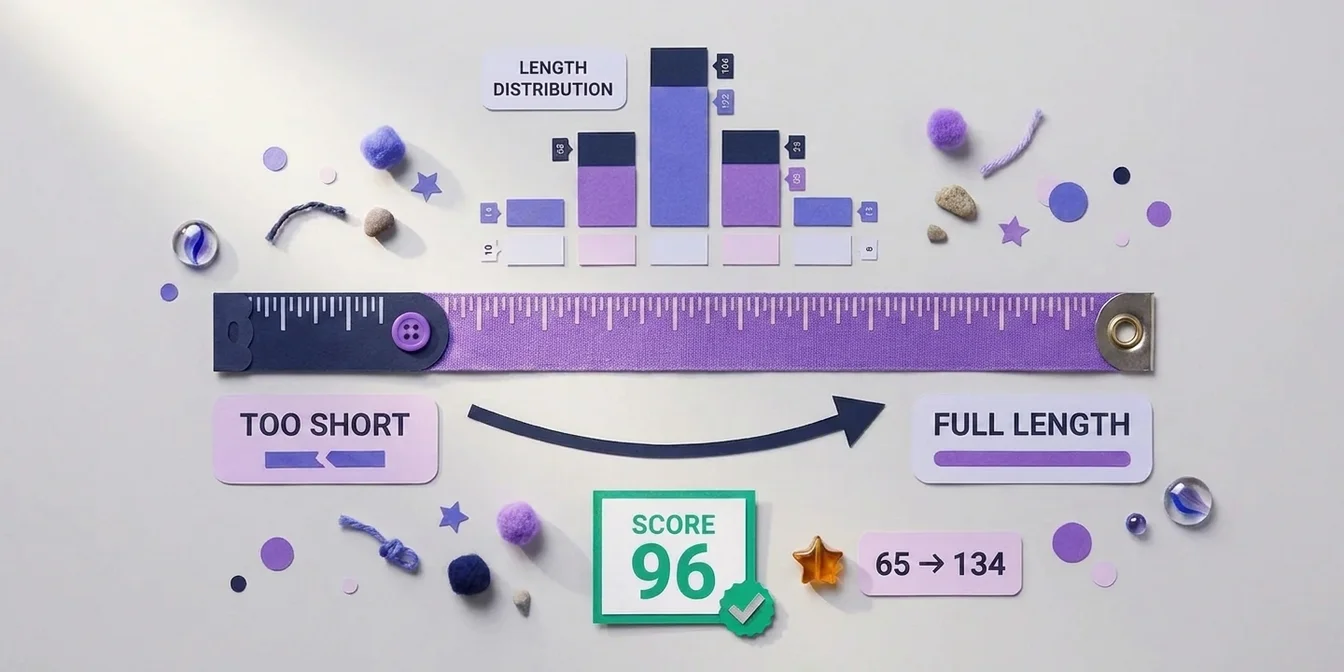
The average Google Shopping title uses just 65 of the 150 available characters. More than half of its matching potential goes unused. That's the headline result from an analysis of roughly 324,000 product titles and 679,307 title optimizations in the FeedOptimizer.AI database (as of June 2026).
Why this matters for your click-through rate (CTR): every unused character is a missed chance to match a real search query. Google indexes all 150 characters for query matching, but if your title ends at 65 characters, it simply can't surface for specific, high-intent searches like "red women's running shoes size 8 waterproof." No match, no impression, no click.
The good news: this is a measurable lever. After optimization, the average quality score in our dataset rose from 61.6 to 96.1 (a gain of 34.5 points).
Where your own titles sit in that distribution takes a few minutes to find out. The free feed check scores every product in your feed with the same engine used for this analysis and shows the titles that leave the most characters unused.
Methodology: what this analysis is based on
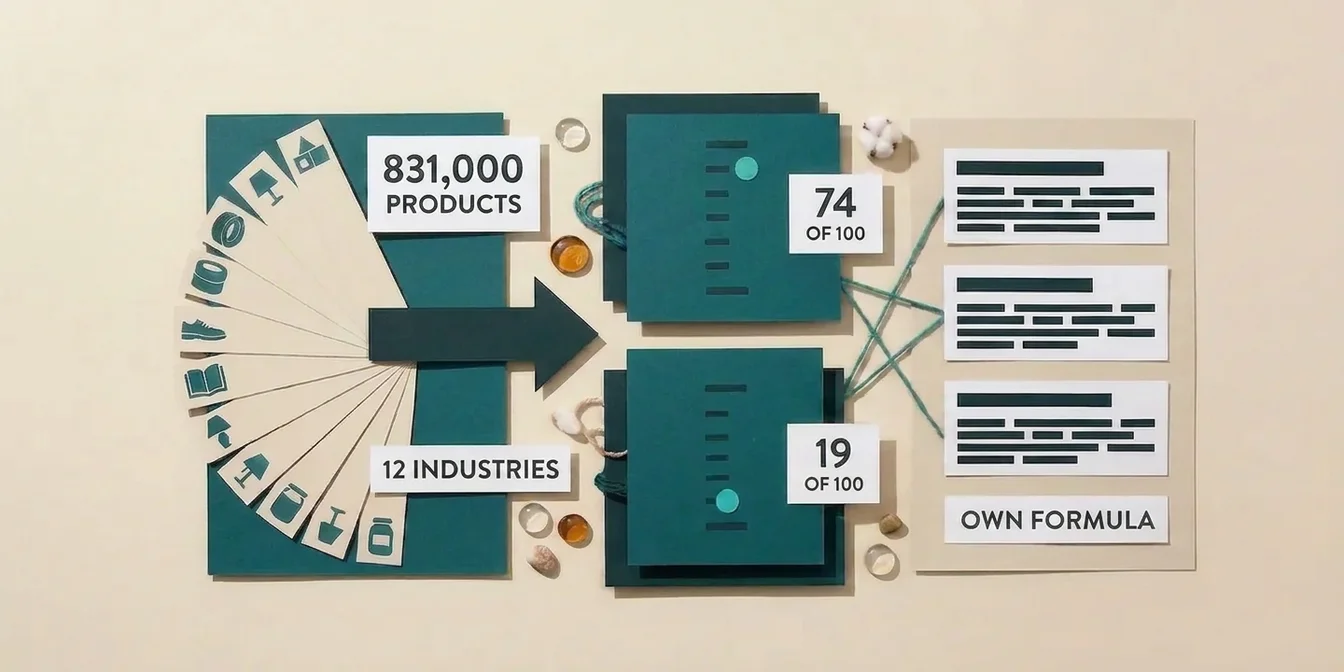
This analysis draws on roughly 324,000 product titles across hundreds of Google Shopping feeds, scored by the FeedOptimizer.AI engine. All figures are aggregated and anonymized. No individual store data is exposed.
| Metric | Value |
|---|---|
| Product titles analyzed | ~324,000 |
| Title optimizations run | 679,307 |
| Avg. title length (before) | 65 characters |
| Avg. title length (after) | 134 characters |
| Analysis period | through June 2026 |
The sample is large enough to reveal genuine patterns rather than isolated cases.
The title-length distribution: a bimodal problem
Google Shopping titles fall into two camps: nearly a third are dangerously short, and just over half are already long. The middle (the supposed "sweet spot") is almost empty. That split explains why blanket advice like "make your titles longer" so often misses the mark.
| Title length | Share | Verdict |
|---|---|---|
| Under 30 characters | 30.9% | Too thin: matches no specific queries |
| 30–50 characters | 8.0% | Borderline |
| 51–70 characters (visible) | 3.4% | Visible range fine, indexing wasted |
| 71–100 characters | 2.6% | Solid |
| 101–150 characters | 51.0% | Uses the indexing space |
| Over 150 characters | 4.1% | Truncated by Google |
Key insight: According to FeedOptimizer.AI benchmark data from June 2026, 30.9% of all Google Shopping titles are shorter than 30 characters. A title like "Men's Running Shoe" is just 18 characters. It passes any eyeball check, but it can't compete for a search like "Nike Pegasus 41 men's running shoe black size 10" because it lacks every differentiating attribute. These 30.9% aren't formatted too long or too short, they simply lack the substance to surface in specific, high-converting queries. This is exactly where the average feed loses the most clicks, long before bids or budgets ever enter the picture.
The other extreme: 4.1% of titles exceed the 150-character limit. Google hard-truncates at 150 characters: any keyword placed beyond that is lost for matching. More isn't automatically better; order is what counts.
What short titles cost your CTR
Shorter titles match fewer queries, and fewer matches mean fewer impressions and fewer clicks. This is where our length data connects with the established CTR research.
The key findings from independent studies:
- +88% CTR when the title exactly matches the search query, and +18% CTR for keyword-optimized titles (Search Engine Land).
- In original research covering 151 shopping ads across 120 advertisers, clicks rose +38% and impressions +39% one week after title optimization; a separate experiment showed +147% impressions and +67% clicks (Store Growers).
- Complete, accurate GTINs generally improve visibility and matching for your listings, according to Google; without one, visibility can be limited.
- In one case study, AI-generated titles raised a retailer's (United RV) conversion rate by +44% over two weeks (DataFeedWatch).
The through-line: CTR comes from relevance, and relevance comes from attributes in the title. When 30.9% of titles sit under 30 characters, they're missing exactly the attributes (brand, model, color, size, material) that high-intent shoppers search for. Our data shows how much title substance is missing on average; the research shows what that missing substance costs in CTR.
Title optimization compared: 65 → 134 characters, score 61.6 → 96.1
Optimization nearly doubled average title length and lifted the quality score by 56%. This isn't a theoretical figure. It's the average across 679,307 real optimizations.
| Metric | Before | After | Change |
|---|---|---|---|
| Avg. title length | 65 chars | 134 chars | +69 chars |
| Title space used | 43% | 89% | +46 pts |
| Avg. quality score | 61.6 | 96.1 | +34.5 points |
What matters is how those extra 69 characters get filled. They aren't padding, they're differentiating attributes, front-loaded by visibility: the most important information in the first 70 visible characters, supporting keywords in the indexed space beyond. Here's the golden formula in practice:
For the full structure with industry-specific formulas, see our guide on optimizing Google Shopping product titles.
What this means for your store
The data points clearly to where the lever is: the too-thin titles, not the ones that are already long. Three concrete steps that fall straight out of the analysis:
- Find your "under 30 characters" products first. Statistically, they're your single biggest CTR leak. Sort your feed by title length and prioritize everything under 30 characters. On average that's nearly a third of your inventory.
- Fill the indexed space up to ~134 characters, but order by visibility. The first 70 characters have to work on a phone screen (brand + product type + key attribute). Characters 71–150 are for the supporting keywords Google uses to match.
- Stay under 150 characters. 4.1% of titles waste keywords because Google truncates hard. Check that your most important terms appear well before character 150.
If you want to go deeper: the most common feed errors and your product descriptions are the next two levers after the title. And in Performance Max, feed quality is your single most important input anyway.
How FeedOptimizer.AI automates title optimization
Nearly a third of titles too short, just over half already long but unstructured. Fixing that pattern by hand across thousands of products doesn't scale. Each title needs a category-specific structure and the right attributes, front-loaded in the right order.
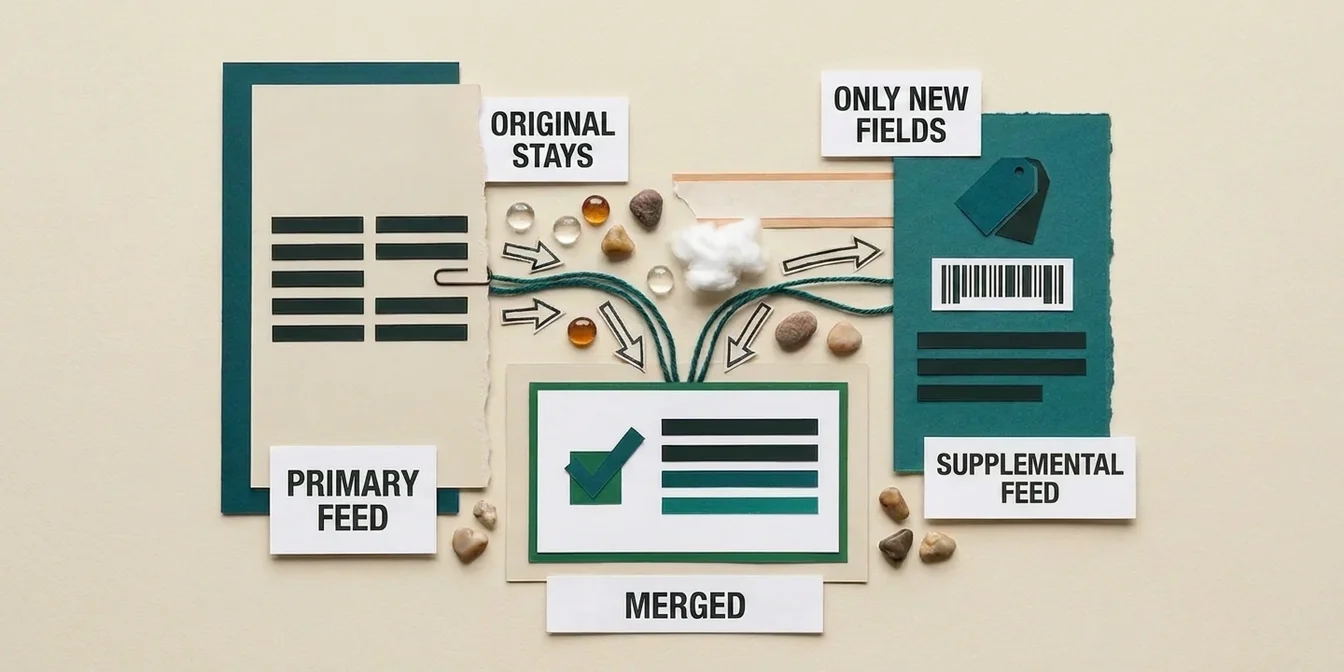
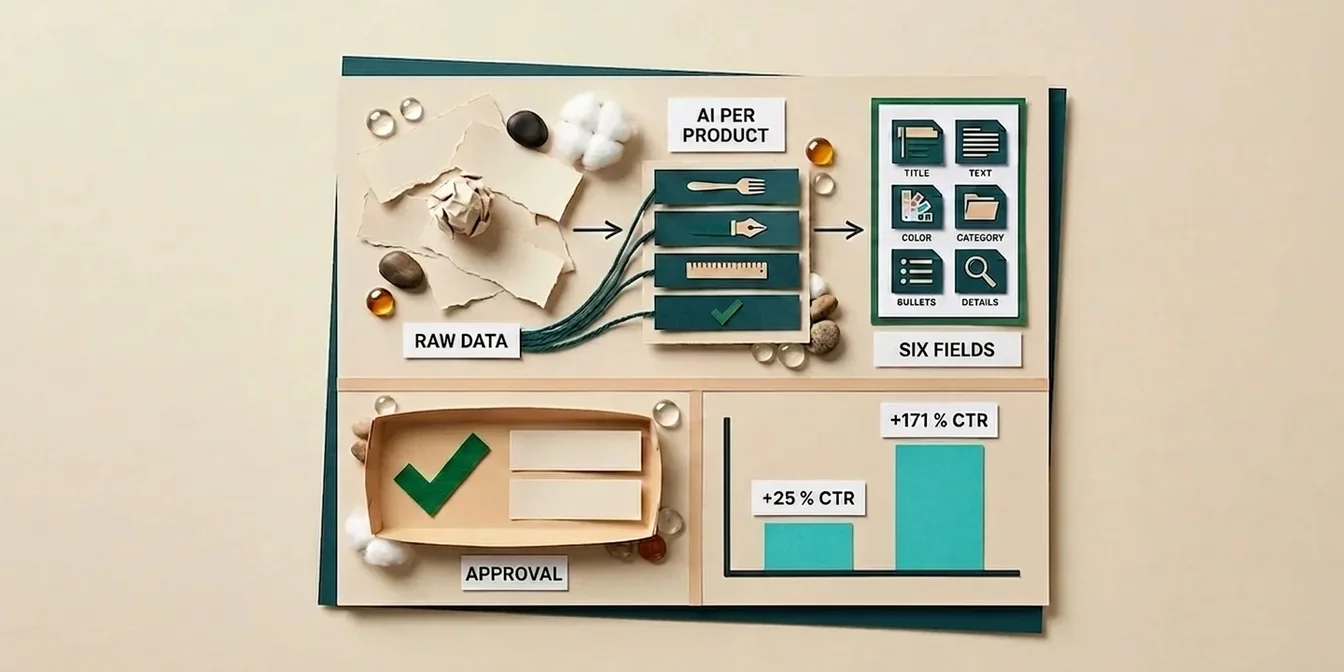
FeedOptimizer.AI analyzes every title individually, detects the optimal structure per product category, fills in missing attributes from your feed, and uses the indexed space without breaking the 150-character limit. That exact process is what lifted the average quality score in our dataset from 61.6 to 96.1. Optimized titles land in your Merchant Center as a supplemental feed. Your original feed stays untouched. Pricing starts at a fraction of what legacy feed tools charge.
Frequently Asked Questions
How long should a Google Shopping title ideally be?
Use the first 70 characters for the purchase-deciding information (brand, product type, key attribute) and fill up to around 130–150 characters with supporting keywords. In our data, average length rose from 65 to 134 characters after optimization, using the indexed space without breaking the 150-character limit.
Why are short titles bad for CTR?
Google matches titles against search queries. A title under 30 characters rarely contains the specific attributes (color, size, model) that high-intent shoppers search for. According to Search Engine Land, an exact match with the query lifts CTR by up to 88%. Without those attributes in the title, that match is impossible.
How many product titles are too short?
According to FeedOptimizer.AI benchmark data from June 2026, 30.9% of all analyzed titles are shorter than 30 characters, and another 8% fall between 30 and 50 characters. That means nearly 40% of titles are potentially too thin to rank for specific queries.
Does simply writing longer titles help?
Only if the added length consists of relevant attributes ordered by visibility. 51% of titles are already 101–150 characters long, so length alone isn't the problem. Order is what matters: the most important keywords belong in the first 70 characters.
Does Google truncate titles that are too long?
Yes. Google enforces a hard 150-character limit. In our data, 4.1% of titles exceed it. Every keyword beyond that point is lost for query matching. Keep your most important terms well before character 150.