Performance Max or Standard Shopping – which should you use?
Use Standard Shopping when you need control, transparency, and have a small, high-margin catalog. Use Performance Max when you want maximum reach across every Google channel and generate at least 30 conversions per month. Most high-performing stores in 2026 run both in parallel – Standard Shopping for control and brand segments, Performance Max for scale. According to an Optmyzr analysis of 24,702 Performance Max campaigns (2024), 82% of advertisers run PMax alongside other campaign types – not as a replacement.
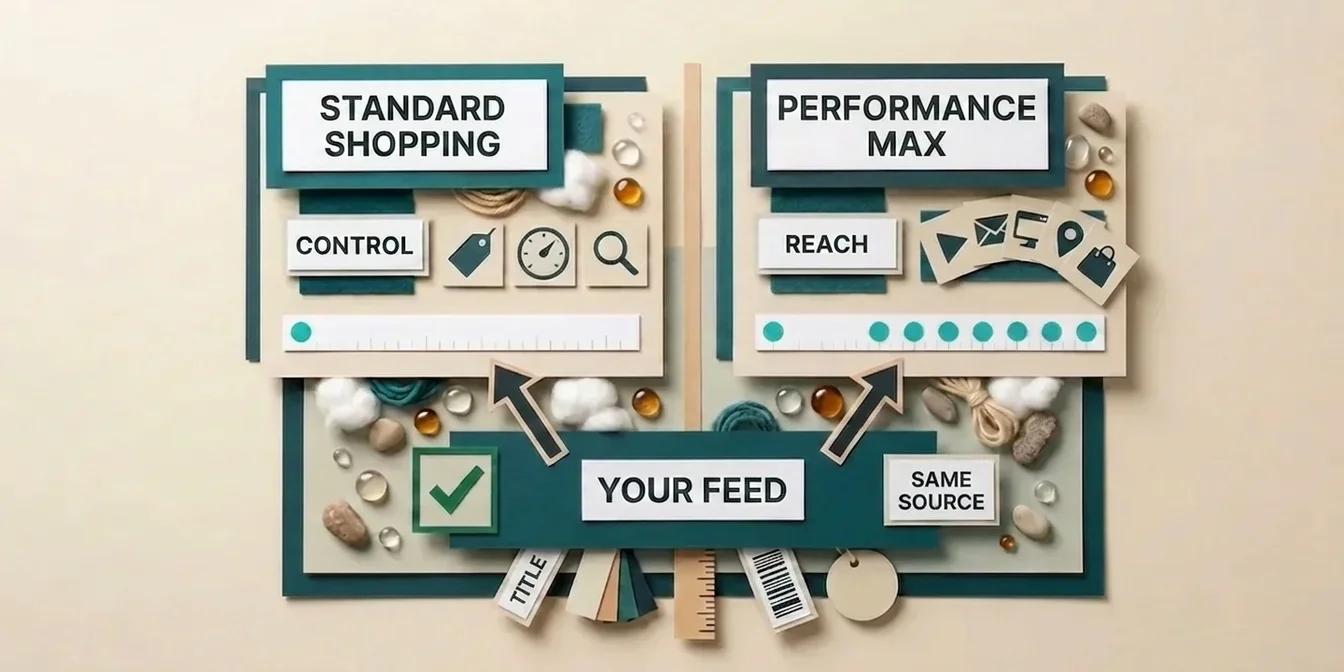
The decision is often framed as "human vs. machine": manual control versus Google's AI. That framing misses the point. Both campaign types pull their product data from the same Google Merchant Center feed – and that feed ultimately decides performance, no matter which campaign type you pick. With Performance Max, a median 90% of budget flows into feed-based Shopping ads, according to SMARTER ecommerce. Solve the campaign question but ignore the feed, and you're optimizing the wrong thing.
This guide gives you the data-driven comparison for 2026: the real differences, current ROAS benchmarks, a clear decision matrix, and the hybrid strategy that industry consensus says works most reliably.
The core difference: control vs. automation
Standard Shopping gives you manual control over bids, search terms, and campaign structure – but only in Shopping results. Performance Max automates everything through Google's AI and serves your products across seven channels. The trade-off is clear: transparency and steerability on one side, reach and automation on the other.
Standard Shopping appears exclusively in Shopping results. You control bids at the product level, set negative keywords, define campaign priority, and see exactly which search queries triggered your ads. Performance Max, by contrast, bundles seven campaign types into one: Shopping, Search, YouTube, Display, Gmail, Discover, and Maps. Google's AI handles bidding, placements, audiences, and asset combinations – based on the goal you set.
| Aspect | Standard Shopping | Performance Max |
|---|---|---|
| Channels | Shopping results only | Shopping + Search + YouTube + Display + Gmail + Discover + Maps |
| Control | Manual bids, negative keywords, priority | Fully automated (Google AI) |
| Structure | Ad groups + product groups | Asset groups + listing groups |
| Search-term visibility | Full | Limited ("black box") |
| Bidding | Manual or Smart Bidding | Goal-based automation |
| Learning period | Ready immediately | 40–60 days |
| Best for | Small/high-margin catalogs, brand defense | Scale, volume, multi-channel |
The single most important practical difference is transparency. With Standard Shopping you see every search term and every product that drives revenue – or wastes budget. Performance Max is a partial black box: you can't see which search terms triggered your ads, and you can't manually adjust bids for individual products or placements.
Most merchants argue over control versus automation – and overlook that both campaign types draw from the same feed. The campaign type is the packaging. The feed is the product.
– Dennis Gerich, Founder & CEO, FeedOptimizer.AI
2026 ROAS benchmarks: what the data really shows
Both campaign types hit comparable ROAS – the difference is in volume and predictability, not raw efficiency. Performance Max tends to deliver more reach and conversion volume, Standard Shopping more control over margin per click. Looking only at average ROAS leads to the wrong decision.
The current 2026 benchmarks paint a nuanced picture:
| Metric | Value | Source |
|---|---|---|
| Average PMax ROAS | 4.1x | WordStream/LocaliQ 2026 |
| Standard Shopping ROAS (higher budgets) | up to 5.2x | Industry benchmark 2026 |
| Median PMax ROAS target | ~6.0x (2022: ~4.7x) | SMARTER ecommerce 2025 |
| PMax target achievement | 95–116% of target | SMARTER ecommerce 2025 |
| Conversion lift from PMax | +12–18% | Google data |
The apparent gap between the 4.1x average and the 6.0x target comes down to the data set: WordStream/LocaliQ averages across all industries and account sizes, while SMARTER ecommerce measures pure ecommerce accounts with an actively set target ROAS. So never compare a raw average against a target.
Performance Max's edge is mostly volume: more conversion value across every channel – bought with 40–60 days of learning and less insight into search-term performance. A controlled Workshop Digital case study shows +21% ROAS, +55% conversion value, and over $13K in incremental revenue after switching from Standard Shopping to Performance Max.
The decisive variable is conversion volume. Performance Max needs at least 30 conversions per month, according to SMARTER ecommerce, before the AI's bidding engages at all; between 60 and 90 conversions, hitting your target ROAS stays roughly a coin flip, and performance only becomes reliable at around 150 conversions. Below 30, results are inconsistent and more miss than hit – the AI simply lacks enough data to learn. This is exactly where small stores lose: they hand Performance Max a budget that never reaches the critical data threshold.
When Standard Shopping is the better choice
Standard Shopping wins wherever control matters more than reach: small high-margin catalogs, brand defense, tight budgets, and accounts that need search-term transparency. If you need different bids per product, or want to know precisely which query converts, Standard Shopping serves you better.
Specifically, Standard Shopping is the right call when:
- You have a small, high-margin catalog – with few products, manual per-item bidding pays off.
- Brand defense is the goal – negative keywords let you isolate branded queries and stop paying for clicks you'd have won anyway.
- Your budget is limited – below 30 conversions per month, Performance Max burns budget in its learning phase.
- You need predictability – Standard Shopping is ready immediately, with no 40–60 day learning period.
- Search-term transparency is business-critical – you see every term and can steer deliberately.
The biggest advantage is diagnosability. When a product doesn't convert, Standard Shopping shows you why immediately – wrong search term, weak title, CPC too high. That clarity is missing in Performance Max. For how to calculate the break-even point per product, see our guide to calculating Google Shopping ROI.
When Performance Max is the better choice
Performance Max is the right choice when you want maximum scale across every Google channel, have a larger budget, and can live with less transparency. The higher reach ceiling makes PMax a growth engine – provided your feed supplies the data quality the AI needs.
Performance Max plays to its strengths when:
- Scale is the primary goal – access to seven channels means far higher growth potential than Shopping alone.
- You generate 30+ conversions per month – only then does the AI have enough data for stable optimization.
- Your budget has headroom – PMax needs learning budget before it delivers.
- You run large or broad catalogs – manual per-product bidding doesn't scale here.
- You want to reach new customers through discovery channels – YouTube, Discover, and Gmail tap demand Shopping alone can't reach.
The catch: Performance Max is only as good as the data you feed it. Because the AI directs 90% of budget into feed-based ads, feed quality becomes the dominant lever. Weak titles, missing attributes, or generic descriptions hurt PMax across every channel at once. We cover the key levers in detail in our guide to Performance Max feed quality.
Summed up as a decision matrix:
| Your situation | Recommendation |
|---|---|
| Small, high-margin catalog (under ~50 products) | Standard Shopping |
| Under 30 conversions per month | Standard Shopping |
| Brand defense / isolating branded queries | Standard Shopping |
| Search-term transparency is business-critical | Standard Shopping |
| Broad catalog (hundreds to thousands of products) | Performance Max |
| 30+ conversions per month with scale as the goal | Performance Max |
| Acquiring new customers via YouTube, Discover, and Gmail | Performance Max |
| Both control and scale segments present | Both (hybrid) |
The hybrid strategy: why most stores run both in 2026
The most successful 2026 strategy isn't "either/or" but "both, with clear roles": Standard Shopping for control and brand segments, Performance Max for scale and new customers. Per Optmyzr, 82% of advertisers already run PMax alongside other campaign types – the only question is whether they do it strategically or by accident.
A proven hybrid structure for ecommerce looks like this:
Segment 1 – Brand & bestsellers (Standard Shopping):
- Your highest-revenue, highest-margin products
- Manual bids, negative keywords against waste
- Full transparency into search terms and margin
Segment 2 – Scale & long-tail (Performance Max):
- The broad catalog, new-customer acquisition across all channels
- Target ROAS as the steering lever, not manual bids
- Enough budget to clear the 30-conversion threshold
Important: since Google moved the Shopping auction to an ad-rank model, Performance Max ads are no longer automatically prioritized over Standard Shopping campaigns – for overlapping products, the campaign with the higher Ad Rank wins. This makes running both cleaner – you can let them coexist without PMax fully cannibalizing your Standard Shopping. Still, you need clear separation via product segments or distinct target ROAS values, or both campaigns will bid on the same products and drive your CPC up.
The common denominator: your feed decides either way
Whether Standard Shopping or Performance Max – both campaign types pull product data from the same Merchant Center feed. Feed quality is the one lever that works regardless of your campaign choice. While Performance Max hands bidding control to Google, the feed stays 100% in your hands. It's the variable with the best cost-benefit ratio in the entire Shopping stack.
This is even more true for PMax than for Standard Shopping. Because Performance Max directs 90% of budget into feed-based ads and auto-generates creatives for every channel from them, each feed attribute has more touchpoints. A precise title becomes a Search headline, a strong image a YouTube thumbnail, a detailed description Display context.
The three levers with the biggest effect – regardless of campaign type:
- Product titles – determine which search queries surface your product. Keyword-first titles measurably lift CTR. Details in our guide to product title optimization.
- Complete attributes – GTIN, color, size, material, product category. Gaps cost you in the auction against better-maintained competitors.
- Clean, error-free data – disapprovals and price mismatches weaken both campaign types. Find the most common pitfalls in our guide to Google Shopping feed errors.
Pull these three levers and you improve performance in Standard Shopping and Performance Max – without raising your budget.
How FeedOptimizer.AI helps with both campaign types
The campaign choice is a strategic decision – feed quality is an operational one. And feed quality doesn't scale manually once you carry hundreds or thousands of products. That's where FeedOptimizer.AI comes in: it optimizes your feed automatically with AI and delivers the improvements as a supplemental feed – your original feed stays untouched.
- Title optimization: AI generates keyword-first titles per product, in the right order, based on category best practices
- Description optimization: unique, keyword-rich copy instead of generic manufacturer boilerplate
- Attribute completion: missing fields like color, material, or product category are filled in automatically
- Quality Score dashboard: see at a glance which products have optimization potential
- Batch optimization: 100, 1,000, or 10,000 products in a single run – not one by one
For how AI-driven feed optimization works in detail, see our guide to AI feed optimization. The workflow: connect your feed, let the AI optimize, review in the Workbench, and upload as a supplemental feed. No manual CSV editing, no overwriting your original feed.
Whichever campaign type you pick: the feed is a deciding factor. .
Frequently Asked Questions
What is the main difference between Performance Max and Standard Shopping?
Standard Shopping gives you manual control over bids, negative keywords, and search-term transparency, but appears only in Shopping results. Performance Max automates everything through Google's AI and serves your products across seven channels – Shopping, Search, YouTube, Display, Gmail, Discover, and Maps. The trade-off: control for reach.
Which campaign type has the better ROAS?
Both hit comparable ROAS. Standard Shopping delivers up to 5.2x at higher budgets; the average PMax ROAS is 4.1x according to WordStream/LocaliQ 2026. The difference is volume: Performance Max brings 12–18% more conversions, Standard Shopping more margin control per click. The raw average matters less than the fit with your catalog.
Should I switch from Standard Shopping to Performance Max?
Not necessarily. Most successful stores run both in parallel in 2026 – 82% of advertisers per Optmyzr. Switch completely only if you generate 30+ conversions per month, scale is your primary goal, and you can give up search-term transparency. For small, high-margin catalogs, Standard Shopping often remains the better choice.
How many conversions does Performance Max need to work?
At least 30 conversions per month for the AI bidding to engage at all. Between 60 and 90 conversions, hitting your target ROAS stays roughly a coin flip, and performance only becomes reliable at around 150 conversions, per SMARTER ecommerce. Below 30, results are inconsistent and more miss than hit because the AI lacks enough data to learn. Small stores on tight budgets often never clear this threshold – for them, Standard Shopping is usually more efficient.
Does feed quality affect both campaign types equally?
Both pull data from the same Merchant Center feed, but Performance Max is even more dependent: per SMARTER ecommerce, a median 90% of PMax budget flows into feed-based ads, from which the AI builds creatives for every channel. A weak attribute hurts PMax across multiple channels at once. Feed optimization is therefore the most effective lever for both types.
Conclusion: feed first, campaign type second
Performance Max or Standard Shopping isn't a matter of belief – it's a question of catalog, budget, and conversion volume. The key takeaways:
- Standard Shopping = control – ideal for small, high-margin catalogs, brand defense, and tight budgets.
- Performance Max = scale – ideal at 30+ conversions/month, with a larger budget and multi-channel growth in mind.
- Hybrid is the 2026 standard – 82% of stores run both, with clear role separation.
- The feed decides either way – 90% of PMax budget is feed-based; feed quality is the one lever that works for any campaign choice.
- Optimize the order – fix the feed first, then choose the campaign type. Not the other way around.
Before your next campaign debate, ask the more important question: is my feed good enough to give whichever campaign you pick the best possible material? Usually the answer is: not yet – and that's exactly where the biggest untapped performance lives.